

Global Broker Regulation Inquiry App
About WikiFX
English
简体中文
繁體中文
English
Pусский
日本語
ภาษาไทย
Tiếng Việt
Bahasa Indonesia
Español
हिन्दी
Filippiiniläinen
Français
Deutsch
Português
Türkçe
한국어
العربية
اردو


Why Are African Currency Spreads So Wide?

WikiFX
|


Abstract:African currency pairs often have spreads many times wider than major pairs due to lower liquidity, higher volatility, and greater economic uncertainty. This article explains the mechanics with a clear hypothetical cost comparison and debunks common myths.

Every forex trade involves two prices: the bid, at which you can sell, and the ask, at which you can buy. The difference between these is called the spread, usually measured in pips (the smallest common price change for a pair). For major currencies like the euro against the US dollar, the spread is often just 0.5 to 2 pips in normal market conditions. That spread is your immediate cost to enter a trade: if you buy at the ask and the price does not move, you need the bid to rise by at least the spread before you can break even.
When you first look at a forex platform, the spread on EUR/USD might be almost invisible. Then you glance at USD/ZAR or EUR/NGN and see a gap that looks enormous. That is not a mistake. It is a normal feature of how currency markets work, and understanding it can save you from costly surprises.
 Contents
Why African Currencies Often Have Wider Spreads
Several factors combine to push the spread on African currency pairs much higher. The most important is liquidity, how easily a currency can be bought and sold without moving the price.
- Lower trading volume: African currencies are not traded nearly as much as the US dollar, euro, or yen. A thin market means fewer buyers and sellers at any moment, so a broker or market maker must quote a wider spread to manage the risk of holding that currency.
- Higher volatility: African economies can experience sharp currency moves because of commodity price swings, political events, or changes in foreign investment flows. To protect themselves, liquidity providers widen the spread during uncertain times or simply keep a wider baseline spread.
- Economic and political uncertainty: Currency values are sensitive to inflation, debt levels, elections, and central bank decisions. Because some African countries have a history of high inflation or currency devaluations, the market prices in a bigger risk premium through a wider spread.
- Time-zone and market overlap: The highest liquidity for African currencies tends to happen when local markets and major financial centres (London, New York) are both open. Outside those windows, spreads can be even wider.
- Interbank market limitations: Many African currencies trade more heavily on their domestic interbank markets, where foreign retail brokers may have limited access. The cost of routing orders through multiple layers adds to the spread a retail trader sees.
All these factors do not mean that trading African currencies is inherently bad, only that the cost structure is different and must be understood.
A Hypothetical Example: Cost in Dollars
To see why the spread matters, let us compare the cash cost of a trade on a few pairs using standard lots (100,000 units of the base currency). This is a purely illustrative calculation with rounded numbers; it is not a live quote or a suggestion.
- EUR/USD: hypothetical spread of 1 pip. For one standard lot, each pip is worth about USD 10. Entering the trade costs you USD 10 in spread.
- GBP/USD: hypothetical spread of 1.5 pips. At a pip value of about USD 10 per lot, the spread cost is around USD 15.
- USD/ZAR: hypothetical spread of 70 pips. With the USD/ZAR exchange rate at 15.0000, one pip is worth about ZAR 10, or roughly USD 0.67. The spread cost per lot is 70 × USD 0.67 ≈ USD 47.
- EUR/NGN (euro against Nigerian naira): hypothetical spread of 120 pips. For pairs quoted with higher exchange rates, the pip is often defined as 0.01 rather than 0.0001. With one standard lot and an exchange rate near 1500, a 120-pip spread would cost about 120,000 naira, which is roughly 80 euros or about 92 US dollars at current rates. The exact cost depends on the pip definition your broker uses.
You can see that the spread alone can eat up a significant part of any small profit, especially if you are trading short-term strategies.
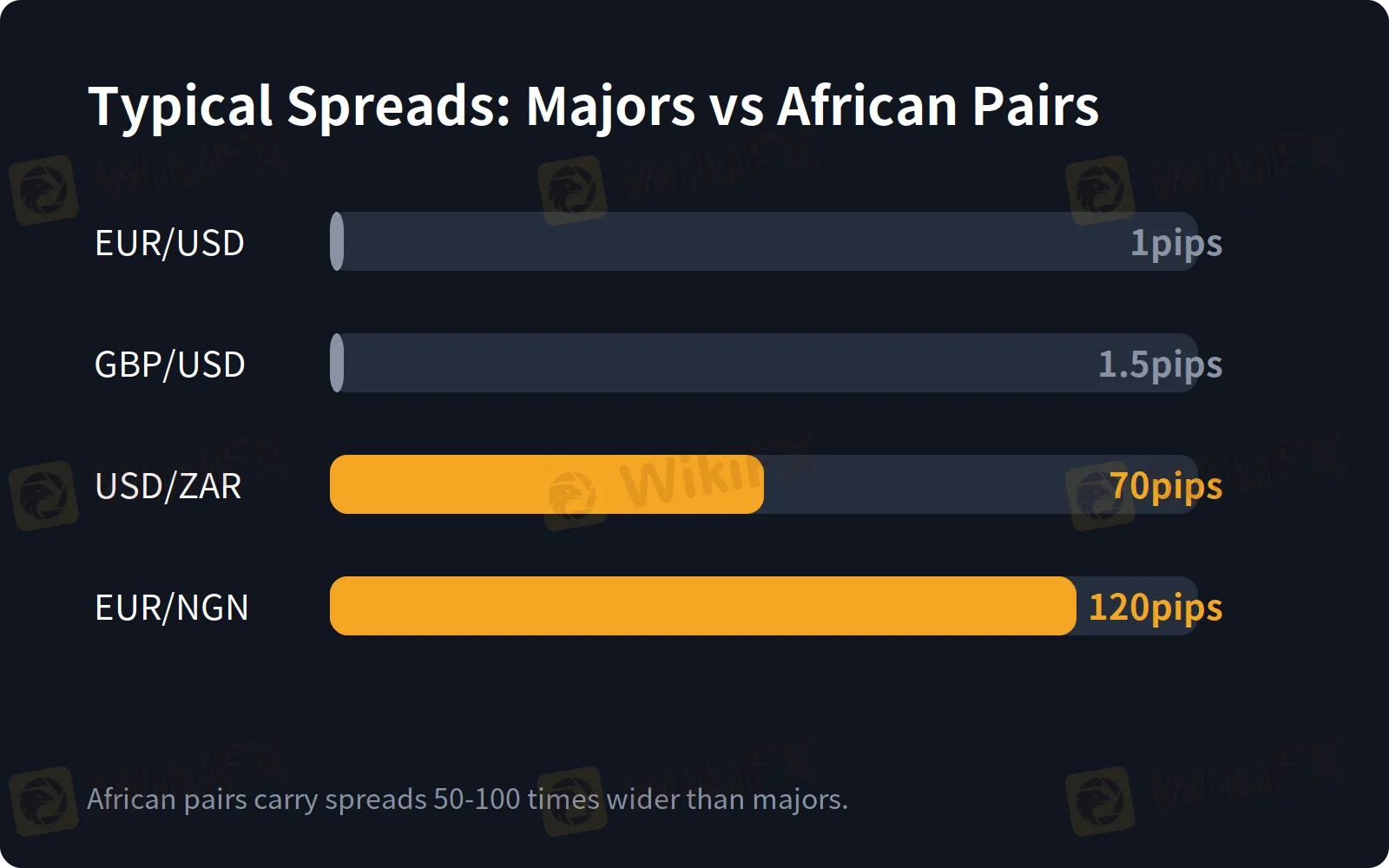
Hypothetical averages; actual spreads vary with market conditions.
Common Misunderstandings About Spreads
Beginners often make a few mistakes when reading spreads on African pairs.
- “The broker is charging an unfair fee.” A wide spread is not necessarily a hidden charge. It reflects the real cost of executing a trade in a less-liquid market. Reputable brokers pass on the costs from their liquidity providers; they are not always adding a huge markup.
- “The spread is the same for all pairs.” Spreads are dynamic and pair-specific. Even within Africa, the South African rand tends to have tighter spreads than, say, the Kenyan shilling or the Ghanaian cedi because it trades more actively.
- “A wide spread means the pair is more volatile and can yield bigger profits.” While volatility is a reason spreads widen, a wide spread does not promise a large move in your favour. It only guarantees a higher entry cost.
- “Spread cost does not matter if I hold the trade for weeks.” For a long-term position, the initial spread matters less as a percentage of an eventual large move. However, for day traders and scalpers who rely on tiny price changes, it can wipe out profits entirely.
What Spreads Can (and Cannot) Tell You
The spread is a window into how the market values risk and liquidity for a particular currency. It tells you:
- How easy or difficult it is to trade that pair right now.
- The minimum price move you need just to break even on a round-turn trade.
- That there is higher uncertainty around that currency compared with a major one.
It does not tell you:
- Which direction the price will move next.
- Whether a broker is trustworthy on its own; always check other factors like regulation and client fund safety.
- That you should avoid the currency. An informed trader may choose to accept the higher cost if their strategy accounts for it.
When you see a spread of 80 pips on an African currency pair, do not panic. Understand why it is there and plan your trade size accordingly. The cost is real, but it is not a scam. It is the price of doing business in a market that works differently from the highly liquid world of EUR/USD.
Disclaimer:
The views in this article only represent the author's personal views, and do not constitute investment advice on this platform. This platform does not guarantee the accuracy, completeness and timeliness of the information in the article, and will not be liable for any loss caused by the use of or reliance on the information in the article.
WikiFX Broker
Latest News
Moneycorp Review: Is This Broker’s License Really Telling the Truth?
WikiFXBYBIT Review: Unregulated Broker Warning After Withdrawal Complaints and Forex Profit Disputes
WikiFXiFX Brokers Review: Is Your Deposit Safe?
WikiFXONE ROYAL Faces SCM Malaysia Warning , What Traders Should Verify Before Funding an Account
WikiFXFINEX Review: Regulated Broker, But One Trader’s Margin Call Complaint Raises Alarm
WikiFXReview 2026: octa Regulation Warnings, Withdrawal Complaints, and Platform Risks
WikiFXWeTrade Broker: Regulated but Is It Really Safe for Traders?
WikiFXHow Public Holidays and Market Hours Shape Forex Liquidity
WikiFXWhy Are African Currency Spreads So Wide?
WikiFXSTONE WALL CAPITAL Review: What Traders Should Know Before Depositing
WikiFX