

Global Broker Regulation Inquiry App
About WikiFX
English
简体中文
繁體中文
English
Pусский
日本語
ภาษาไทย
Tiếng Việt
Bahasa Indonesia
Español
हिन्दी
Filippiiniläinen
Français
Deutsch
Português
Türkçe
한국어
العربية
اردو



How to Pick a Leverage Ratio That Won't Blow Your Account

WikiFX
|


Abstract:Leverage is a loan that lets you control a larger forex position with a smaller deposit, but it magnifies losses just as easily as gains. This article explains how leverage really works with a hypothetical margin calculation and outlines factors to consider, without telling you what to pick.

 Contents
What Leverage Actually Does
In forex trading, leverage is a loan from your broker that lets you control a larger position than your account balance would normally permit. Its expressed as a ratio, such as 1:100, meaning for every $1 of your own money set aside as margin, you can trade up to $100 in the market. The broker holds this margin as a security deposit; if losses eat into it, the broker will close your position to prevent a negative balance.
A common beginner mistake is thinking higher leverage automatically means higher profit. Thats not true. Leverage only allows you to open a bigger position with the same capital. The actual profit or loss comes from the position size the trade itself. The pip value, how much your account changes per tick of price, is determined by position size, not by the leverage ratio you picked. Leverage merely sets the collateral requirement.
The margin calculation is simple: Margin Required = Notional Value ÷ Leverage Ratio. Notional value is the full market worth of the trade in your account currency. To show this, let‘s use a purely hypothetical example with numbers you can check. Suppose you have a $1,000 account and consider a one mini lot trade (10,000 units) of EUR/USD at an exchange rate of 1.1555. The notional value is $11,555 (10,000 × 1.1555). Here’s how much margin you would need at different leverage settings:
- 1:10 → $1,155.50
- 1:30 → $385.17
- 1:100 → $115.55
- 1:500 → $23.11
Notice that with 1:10, the required margin exceeds the account balance, so this trade cannot be opened. With 1:500, only $23.11 is tied up, leaving nearly the entire account free. That freed up buying power can create an illusion: a small account now controls a position many times its size. Yet the risk is not from the leverage number but from the size you choose. A 20-pip adverse move on a mini lot costs $20, exactly 2% of a $1,000 account, regardless of whether you used 1:30 or 1:500 leverage.
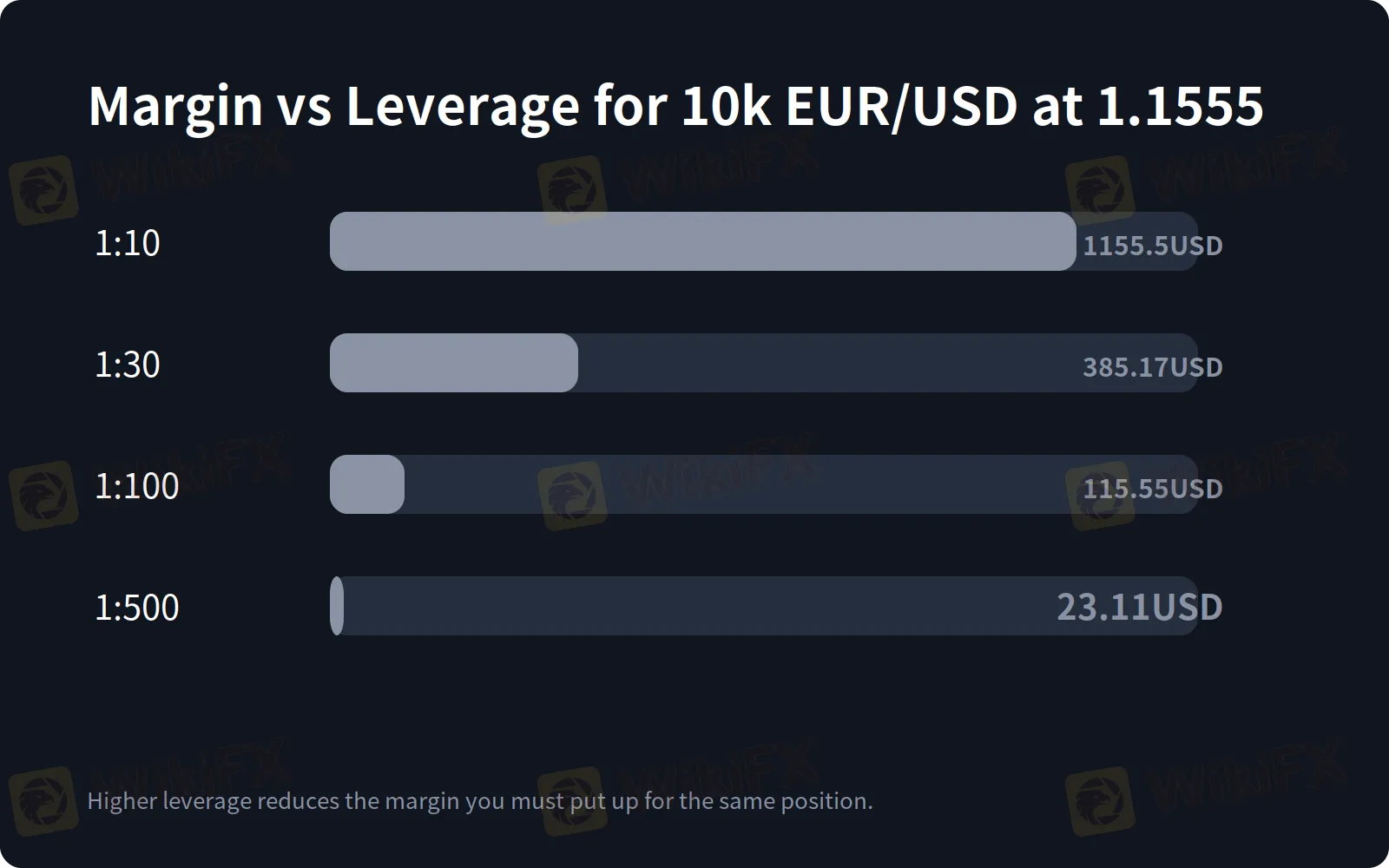
Hypothetical margin requirements for a 10,000-unit EUR/USD trade. These numbers assume an account currency of USD and an exchange rate of 1.1555.
How a Big Position Magnifies Everything
To see the real effect, keep the same account but increase the trade size. Imagine you decide to open one standard lot (100,000 units) of EUR/USD at 1.1555. Notional value becomes $115,550. Compare the margin at two extremes:
- With 1:30 leverage: $3,851.67 (impossible with $1,000)
- With 1:500 leverage: $231.10 (well within the $1,000 balance)
Only the high-leverage setting allows the trade. Now look at the profit and loss. Each pip on a standard lot is worth about $10. If price moves 20 pips against you, you lose $200, or 20% of your account. If it moves 20 pips in your favor, you gain the same. This magnification is entirely due to the outsized position, not the leverage ratio. The leverage simply opened a door that a cautious trader might leave locked.
This hypothetical walkthrough reveals a key point: leverage is a tool for capital efficiency, not a profit engine. It lets you do more with less, but it doesn‘t change how pips translate into dollars. Many regulators cap retail leverage to 1:30 or 1:50 because they’ve observed that extremely high leverage often leads to rapid account losses among inexperienced traders.
What to Bear in Mind When Setting Your Leverage
Since leverage only adjusts the margin you post, the choice should flow from practical needs, not the hope of quick gains. Here are factors that often influence a traders decision, though none are rules:
- Account size and minimum trade. A smaller account may need higher leverage just to meet the margin for the broker‘s smallest allowed trade. But that doesn’t mean you must use the maximum. For a $1,000 account and a mini lot, even 1:30 leverage uses less than 40% of the balance as margin, so extreme ratios are not required.
- Trading style. A short-term scalper opening many small positions might find that higher leverage helps keep margin usage low and free up capital for other trades. A swing trader who holds positions for days and uses wider stop-losses might prefer lower leverage to avoid being closed out by temporary price swings.
- Risk discipline. Many traders first define their stop-loss distance in pips and the maximum account percentage they‘re willing to risk on a trade. That lets them calculate a maximum position size. Only then do they check what leverage is needed to cover the margin for that size. This approach keeps the decision rooted in risk control rather than in the excitement of large exposure.
- Emotional response. High leverage can feed an illusion that a small account will quickly produce large returns. A string of losses can then trigger revenge trading and even bigger positions. If you feel compelled to check your account every few minutes or experience a rush when a trade moves your way, the leverage you’re using may not match your emotional comfort.
- Regulatory limits. Some jurisdictions cap retail leverage; these limits exist as a buffer, not a guarantee. They remind traders that more leverage means less room for error.
The bottom line is that leverage itself doesnt blow accounts, oversized positions do. Keeping position size in check relative to your account equity and stop distance helps ensure that the lever points away from your balance.
Disclaimer:
The views in this article only represent the author's personal views, and do not constitute investment advice on this platform. This platform does not guarantee the accuracy, completeness and timeliness of the information in the article, and will not be liable for any loss caused by the use of or reliance on the information in the article.
WikiFX Broker
Latest News
iFX Brokers Review: Is Your Deposit Safe?
WikiFXONE ROYAL Faces SCM Malaysia Warning , What Traders Should Verify Before Funding an Account
WikiFXASIC Crackdown Hits 5-Year High: 150 Rogue Operators Banned
WikiFXMoneycorp Review: Is This Broker’s License Really Telling the Truth?
WikiFXBYBIT Review: Unregulated Broker Warning After Withdrawal Complaints and Forex Profit Disputes
WikiFXSECP Refers Blink Capital to FIA Over Rs446.6m Alleged Fraud
WikiFXHow to Start a Forex Broker in 2026: Build the Operating Model Before You Buy the Platform
WikiFXEMAR MARKETS Review 2026: Severe Withdrawal Complaints and Risk Signals
WikiFXTrader's Way Review: Trades Vanished Overnight , And There's No Regulator to Call
WikiFXLockwood Review: AMF-Blacklisted Broker with Users Reporting Blocked Withdrawals
WikiFX