

Global Broker Regulation Inquiry App
About WikiFX
English
简体中文
繁體中文
English
Pусский
日本語
ภาษาไทย
Tiếng Việt
Bahasa Indonesia
Español
हिन्दी
Filippiiniläinen
Français
Deutsch
Português
Türkçe
한국어
العربية
اردو


Is XTRADE Safe? 2026 Review of Its License Status, Warnings, and User Complaints

WikiFX
|


Abstract:XTRADE review 2026: WikiFX score 1.78/10, no valid forex license, revoked and abnormal license records, official warnings, Philippine fraud case links, and repeated withdrawal complaints.
 Contents
XTRADE Profile
XTRADE presents itself as an online CFD trading brand with several years of operating history. But its current WikiFX profile tells a very different story.
The brokers WikiFX score is only 1.78/10. It is marked Not Regulated, with Regulation 0.00, License 0.00, and Risk Control 0.00. The license section shows that no valid forex trading license has been found.
The broker page also carries a direct risk warning: XTRADE lacks valid forex regulation, and its score has been lowered due to unresolved client complaints.
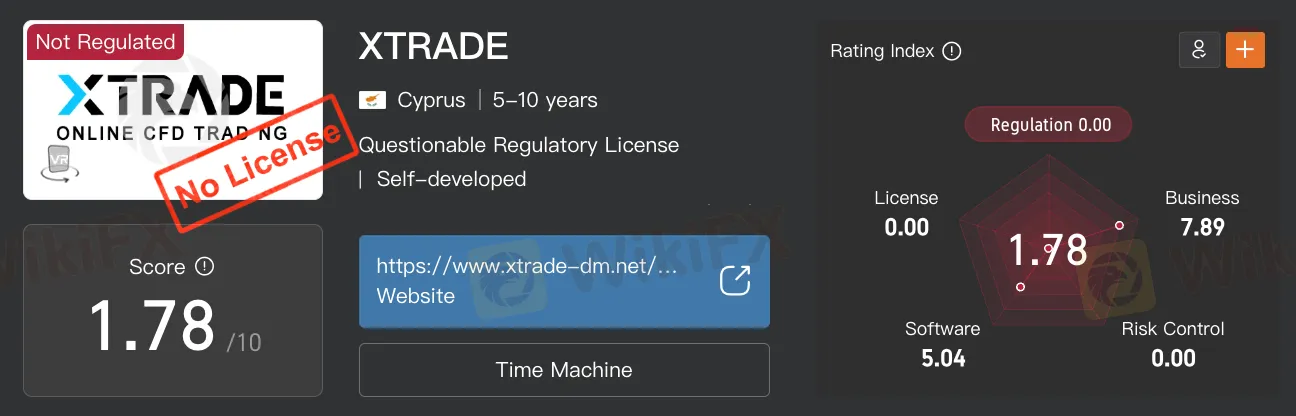
Broker page: https://www.wikifx.com/en/dealer/0361406199.html
XTRADE License Status: No Valid Forex License Found
The current license picture is one of the clearest warning signs around XTRADE.
At present, XTRADE has no valid forex trading license on its WikiFX profile. Older license records do not improve the picture. Instead, they show a trail of abnormal or unusable regulatory status.
The historical license records include:
- FSC — Xtrade International Ltd — Common Financial Service License — Exceeded
- ASIC — Xtrade International Ltd — Market Making License — Revoked
- CySEC — Merba Limited — Market Making License — Suspicious Clone
XTrade.AUs Australian financial services license was formally cancelled by ASIC on 26 April 2024. The company appealed to the Administrative Appeals Tribunal and sought a stay of the cancellation decision, but the stay application was refused. The cancellation therefore remained in effect.
XTRADE has also been linked to claims involving Belize FSC and South Africa FSCA licenses. Independent checks show that the Belize license is no longer valid, while the South African license details do not match the information promoted by the broker.
That leaves a simple conclusion: the brand may still appear online, but the current license record does not support confidence.
Official Warnings: Japan, Malaysia, Spain, and More
XTRADE has appeared in warning records from multiple authorities.
Japan‘s financial authorities issued a warning involving Xtrade International Ltd for operating financial instruments business without registration. Malaysia’s Securities Commission also listed XTRADE in its investor alert records. Spains CNMV has identified XTRADE as an unauthorized entity providing investment services without approval.
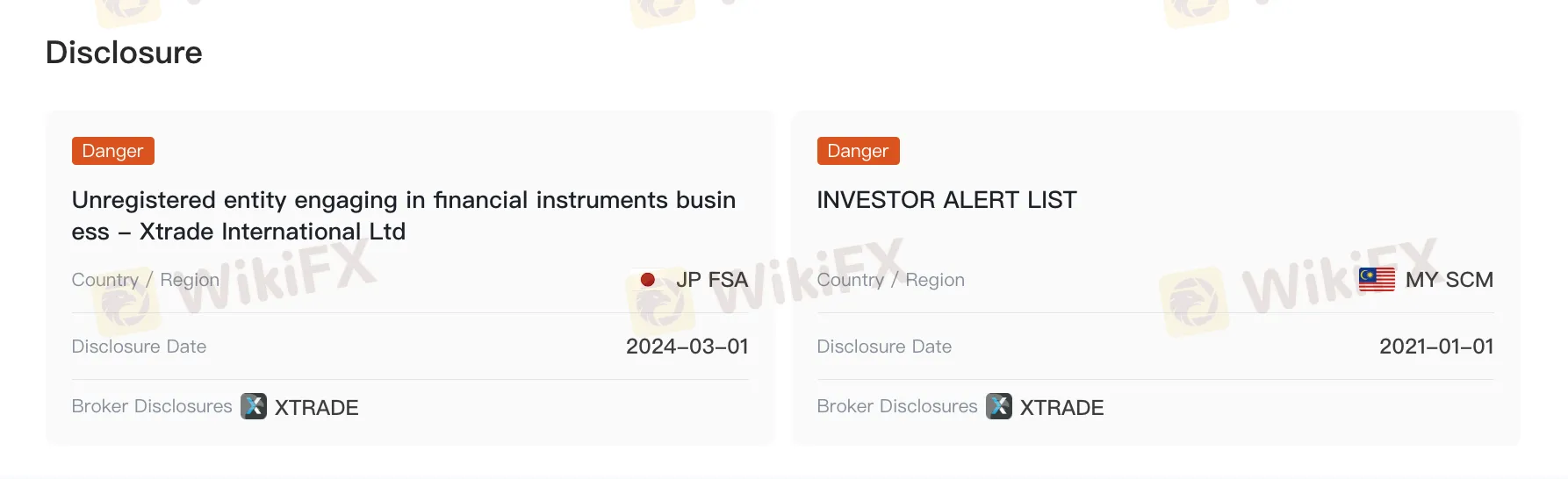
When a broker appears in several warning systems across different markets, the issue is no longer just about one local dispute. It becomes a wider regulatory pattern.
Philippines Case: XTRADE Named in Online Investment Fraud Operation
The most alarming recent case came from the Philippines.
In May, Philippine authorities raided a large online investment fraud operation in Barangay San Antonio, Pasig City. The raid led to the arrest of 63 suspects, including an alleged foreign mastermind.
According to the Philippine National Police Anti-Cybercrime Group, the case began after victims said they were lured through online advertisements and people posing as trading assistants or investment advisers. Authorities said the operation used marketing staff, telesales agents, and client retention agents to push victims into investing through a platform called XTRADE.
Investigators also found that the group allegedly used scripted messages, false identities, repeated deposit pressure, and withdrawal manipulation to make the platform appear legitimate.

This is not an ordinary “bad trading experience” case. The reported structure looks closer to a coordinated sales machine: online ads bring in targets, so-called advisers build trust, telesales staff push deposits, and withdrawals become the point where the illusion starts to break.
For any XTRADE review, this case is impossible to ignore.
Changing Names, Changing Domains, Same Risk Pattern
The Philippine investigation also exposed another issue: the use of multiple XTRADE-related websites.
Police checked computers and mobile phones seized at the site. According to the information disclosed, telesales staff in the same office used the same scripts while the backend system controlled several XTRADE derivative websites.
Investigators also stated that the group had changed company names and web addresses over nearly 10 years. Client data, deposit bank accounts, and backend systems used to control or adjust trading displays were reportedly connected to the same foreign mastermind.
This is a familiar pattern in high-risk online trading operations. Once one domain draws attention, a similar domain can appear. Once one company name becomes exposed, another name can be used. The surface changes, but the deposit channel, sales scripts, and user data may remain connected.
For XTRADE, this makes domain verification especially important. A similar name, a slightly different website address, or a familiar logo does not prove that a platform is legitimate.
User Complaints on WikiFX: Withdrawals, Deposits, and Adviser-Led Losses
XTRADE currently has 35 exposure records on WikiFX.
The complaints focus mainly on:
- withdrawal delays or failed withdrawals
- requests for additional deposits before funds can be released
- users being guided by so-called assistants or advisers
- suspected fake trading arrangements
- losses after repeated top-ups
- difficulty recovering deposited money
- claims of misleading investment guidance
One complaint describes a pending withdrawal. The user said the withdrawal remained unresolved after communication with the platform, while the account showed funds that could not be successfully taken out.
Another complaint describes adviser-led trading guidance. The user said they were encouraged to deposit more after losses, while the trading process and communication made the platform appear more like an inducement scheme than a normal broker relationship.
These complaints are not all written in the same way, but they point toward the same pressure points: money goes in easily, withdrawals become difficult, and communication often shifts toward asking for more funds.
What the XTRADE Risk Signals Show
XTRADEs current profile contains multiple warning signals at the same time:
- WikiFX score of 1.78/10
- no valid forex trading license
- regulation and license scores both at 0.00
- risk control score at 0.00
- ASIC license revoked
- FSC record exceeded
- CySEC-related record marked as suspicious clone
- warnings from Japan, Malaysia, and Spain
- connection to a Philippine online investment fraud case
- 35 user exposure records on WikiFX
One negative record may sometimes be explained. XTRADE has far more than one. The risk profile is built from licensing problems, public warnings, law-enforcement reports, and user complaints that repeatedly mention withdrawals and deposit pressure.
Final Assessment: Is XTRADE Safe?
XTRADE does not currently show the profile of a safe, well-regulated broker.
Its WikiFX score is very low. No valid forex license is found. Historical license records are revoked, exceeded, or marked as suspicious. Several regulators have issued warnings. The Philippine case adds a serious enforcement-linked concern, with authorities describing a large online investment fraud operation using the XTRADE name.
The user complaint pattern also supports caution. Many reports focus on failed withdrawals, extra deposit requests, adviser-led trading, and difficulty recovering funds.
For now, XTRADE should be treated as a high-risk broker. Before sending any money, users should verify the exact legal entity, domain, license number, and deposit recipient. In XTRADEs case, the available signals point to one conclusion: this is not a broker profile that deserves blind trust.

Disclaimer:
The views in this article only represent the author's personal views, and do not constitute investment advice on this platform. This platform does not guarantee the accuracy, completeness and timeliness of the information in the article, and will not be liable for any loss caused by the use of or reliance on the information in the article.
WikiFX Broker
Latest News
FINEX Review: A+++ Rating Does Not Remove Risks - How to Read Spread, Withdrawals & Other Aspects
WikiFXUS PPI Cools, but the Core Number Tells a More Complicated Story
WikiFXSingapore Nabs 270 Suspects in RM17 Million Scam Bust
WikiFXBX Trade Review: Is a $1 Minimum Deposit Worth the No-Regulation Risk?
WikiFXRinggit climbs vs US dollar as markets await inflation data
WikiFXFizmo Fx Markets Review 2026: Unregulated Status and Withdrawal Complaints
WikiFXJust Markets Review: 1.82 Score and No Regulation Despite Positive Reviews
WikiFXWhy Importers Panic When Dollars Dry Up, and Why You Should Care
WikiFXTier 1 Liquidity Forex in 2026: What Institutional Really Means for a Broker
WikiFXVestrado Review: A 4.84 Score, an Offshore Base and an FSCA Status Worth Verifying
WikiFX