


Global Broker Regulation Inquiry App
About WikiFX
English
简体中文
繁體中文
English
Pусский
日本語
ภาษาไทย
Tiếng Việt
Bahasa Indonesia
Español
हिन्दी
Filippiiniläinen
Français
Deutsch
Português
Türkçe
한국어
العربية
اردو
Why The Market Reverses Right After You Press Buy
Abstract:Many beginners believe the market actively targets their small accounts when trades immediately reverse. This article breaks down the behavioral finance traps driving this illusion and explains how mechanical position sizing and crowd psychology analysis can protect your capital.
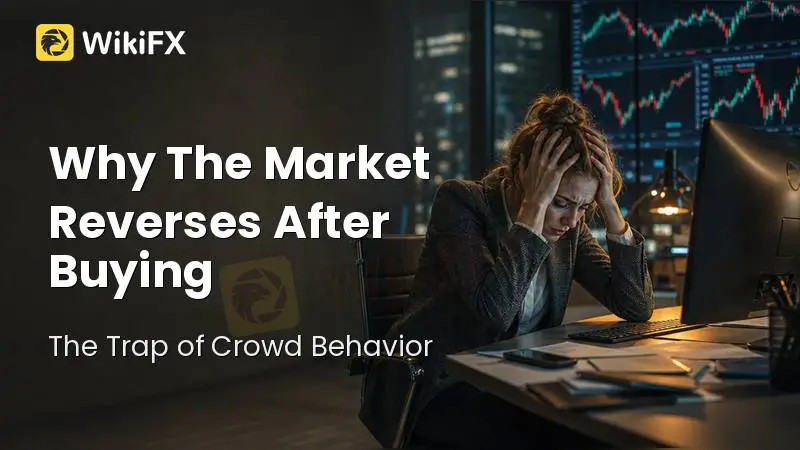
Every beginner knows the feeling. You watch a major currency pair climb steadily. It looks like a clear trend. You finally enter a buy order, and almost immediately, the price drops. You sell to cut your loss, and suddenly the chart shoots up again. It feels like the market has a camera on your screen and is actively hunting your capital.
This is a classic retail illusion. The market is not tracking your account balance. What you are actually experiencing is the heavy impact of crowd psychology, bad timing, and poor position sizing.
 Contents
The Trap of Crowd Behavior
Many beginners fail because they treat the market as a perfectly rational machine. Financial textbooks claim that prices reflect all available economic information. But if markets were entirely logical, there would be no extreme bubbles or sudden crashes.
In reality, price action is driven by the collective mood of market participants. Behavioral finance shows that human emotions—specifically fear, greed, and the urge to follow the herd—disrupt logical price models.
When you finally decide to buy after a long upward run, you are suffering from herd behavior. You are joining the crowd right when broad optimism has peaked. This is exactly when institutional “commercial” traders step in. These large players trade without emotion. They naturally sell into strength when the crowd is euphoric. If you buy at the peak of the crowd's excitement, you become the liquidity they use to exit their positions.
Two Biases That Drain Your Capital
Once you are stuck in a bad trade, two specific psychological biases start destroying your discipline.
The first is loss aversion, which creates the “disposition effect.” Humans hate taking losses much more than they enjoy taking profits. Because of this, when your trade goes negative, you hold on to it, hoping it will eventually turn around so you can break even. Conversely, when you get a tiny profit, you close the trade too early out of fear that the market will take it back. You end up with a track record of massive losses and tiny wins.
The second block is the gamblers fallacy. After a few painful losses, beginners assume a winning trade is statistically “due.” They increase their lot size to win back the money faster.
In 1992, researcher Ralph Vince conducted an experiment with 40 doctorates who had no trading background. He gave them a computer simulation with a verified 60% win rate. At the end of 100 trades, 95% of them had lost money. Even with the odds completely in their favor, they let greed and fear dictate their bet sizing. They increased their risk after losing streaks, assuming luck had to balance out, and blew their capital.
Fixing the Math With Mechanical Sizing
To break this cycle, you need to turn your trading into a mechanical process. A mechanical approach forces you to take trades based on your system's rules, regardless of how you feel about the market.
Start by strictly controlling your position size. The safest starting rule is to never risk more than 1% of your total capital on a single trade. If you have a $1,000 account, your position must be sized so that your maximum loss is exactly $10.
Do not choose a random stop-loss distance just to make the math work. Instead, figure out where your stop loss logically goes based on the market's current volatility—often measured by tools like the Average True Range (ATR)—and then adjust your lot size to ensure the risk stays at 1%. If you respect this mathematical law, the law of large numbers works for you. A string of bad luck will no longer wipe out your account.
The market is not an enemy targeting your funds. It is just a massive crowd making emotional decisions. When you blame a “manipulated” market for your losses, you ignore your own psychological mistakes. To give yourself peace of mind, verify your broker's regulatory status on the WikiFX app to ensure you are trading on a fair platform. Once you know your broker is honest, you can stop looking for external excuses and focus on your true edge: strict risk management, mechanical execution, and an unemotional approach to crowd behavior.


Disclaimer:
The views in this article only represent the author's personal views, and do not constitute investment advice on this platform. This platform does not guarantee the accuracy, completeness and timeliness of the information in the article, and will not be liable for any loss caused by the use of or reliance on the information in the article.
WikiFX Broker
Latest News
The May inflation numbers are due out Wednesday morning. Here's what to expect
 WikiFX
The Market's Ledger: Why Price Returns to Fill Liquidity Voids
WikiFXIndia Left Reeling as Net FDI Crashes from $28 Billion to Just $1 Billion in Two Years
WikiFXTenX Prime Review: PAMM Blackout, Login Blocks, and Broker Regulation Questions
WikiFXInstaForex Review: Broker Profit Deductions, Login Shock, and Regulation Red Flags
WikiFXPosition Sizing Math For Steady Small Account Growth
WikiFXOcta Review 2026: Severe Withdrawal Complaints and Regulation Warnings
WikiFXUniglobe Markets Review 2026: Should You Trade with This Broker?
WikiFXWorld Cup · Forex Predict & Win Event
WikiFXZenstox Review 2026: Unexplained Profit Cancellation & Account Termination Allegations
WikiFXCurrency Calculator
USD

CNY
Current Rate:0
Enter amount
USD
Redeemable Amount
CNY
Calculate 