Abstract:Every broker with a marketing budget now slaps the letters "ECN" on its homepage. Few of them actually deliver what those letters promise. For a serious trader — a scalper, a day trader, an algo trader, anyone whose edge lives or dies on execution quality — the gap between a true ECN broker and a market maker wearing an ECN costume can quietly cost you hundreds of pips a year in slippage, requotes, and inflated spreads. So we cut through the marketing, looked at the brokers that genuinely offer raw pricing and deep liquidity, and cross-checked every one of them on WikiFX. Here are the six ECN accounts that actually earn the label in 2026 — ranked.
First, a short primer, because understanding ECN is what lets you judge these brokers properly.
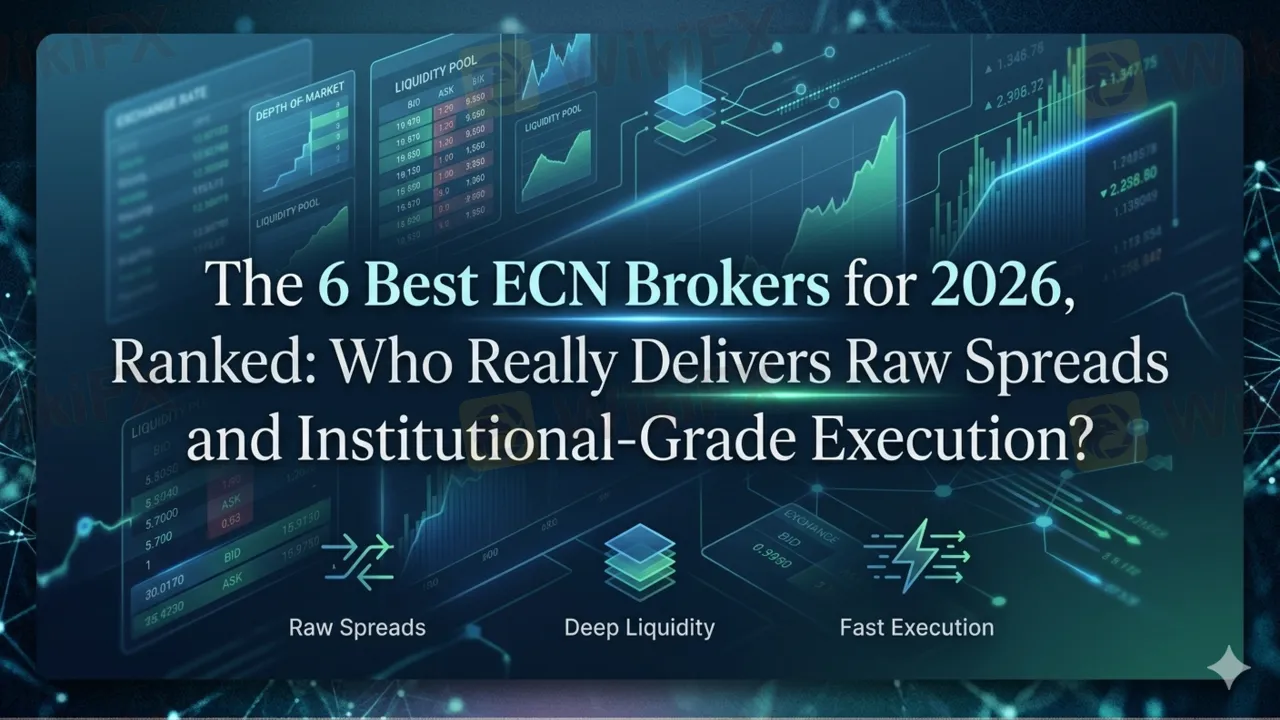
Every broker with a marketing budget now slaps the letters “ECN” on its homepage. Few of them actually deliver what those letters promise. For a serious trader — a scalper, a day trader, an algo trader, anyone whose edge lives or dies on execution quality — the gap between a true ECN broker and a market maker wearing an ECN costume can quietly cost you hundreds of pips a year in slippage, requotes, and inflated spreads. So we cut through the marketing, looked at the brokers that genuinely offer raw pricing and deep liquidity, and cross-checked every one of them on WikiFX. Here are the six ECN accounts that actually earn the label in 2026 — ranked.
First, a short primer, because understanding ECN is what lets you judge these brokers properly.
What an ECN Account Actually Is
A market maker broker takes the other side of your trade — when you lose, it often wins, which creates an obvious conflict of interest. An ECN (Electronic Communication Network) broker does something fundamentally different: it routes your orders directly into a network of liquidity providers (big banks and institutions), matching you with the best available price in the real market. There is no dealing desk standing between you and your fill.
The trade-off is the cost structure. Because the broker is not profiting from a marked-up spread, it charges a transparent commission instead — and in exchange you get raw spreads that can start at 0.0 pips. For active traders, that combination of tight spreads plus a fixed commission usually works out cheaper overall than a “commission-free” account with wide spreads.
Two more terms to watch: execution speed (measured in milliseconds — lower is better, since slow fills cause slippage) and liquidity depth (more liquidity providers means tighter, more stable pricing, especially during volatile news). Judge an ECN broker on those, not on the buzzword. Now, the list.
#1 — IC Markets Global: The True-ECN Benchmark
WikiFX Score: 9.10 | Regulation: ASIC (Australia), CySEC (Cyprus), FSA (Seychelles) | Raw spread from 0.0 pips | Commission: $3 (cTrader) to $3.50 (Raw) per side
IC Markets is, by broad industry consensus and a stellar WikiFX score of 9.10, the ECN broker to beat. It connects traders to 50+ liquidity providers, delivers execution speeds frequently cited under 40 milliseconds, and offers raw spreads from 0.0 pips with EUR/USD often averaging near 0.1 pips in live conditions. You can trade on MT4, MT5, or cTrader, and high-volume traders can step down to its Raw Pro ($1.50 per side) and Raw Pro+ ($1 per side) tiers. Triple-jurisdiction regulation, deep liquidity, and best-in-class infrastructure make IC Markets the default recommendation for anyone who treats execution quality as non-negotiable.
If you are building a scalping or algorithmic strategy, this is the environment to test it in.
#2 — FP Markets: The Veteran's Choice for Raw Pricing
WikiFX Score: 8.67 | Regulation: ASIC (Australia), CySEC (Cyprus) | Raw spread from 0.0 pips | Commission: ~$3 per side
With more than 20 years behind it and a strong WikiFX score of 8.67, FP Markets pairs genuine ECN-style pricing with the stability of a broker that has survived multiple market cycles. Its Raw account offers spreads from 0.0 pips (EUR/USD frequently around 0.1 in practice), a commission near $3 per side, and fast execution under 40ms. Crucially, it offers real platform variety — MT4, MT5, cTrader, and TradingView — so you are not locked into one ecosystem. It is especially praised for tight pricing on cross pairs and exotics, where many competitors widen out. For traders who want raw spreads plus a long, clean track record and dual tier-one-adjacent regulation, FP Markets is a standout.
#3 — Tickmill: The Lowest-Cost ECN Engine
WikiFX Score: 7.62 | Regulation: FCA (UK), CySEC (Cyprus), FSCA (South Africa), FSA (Seychelles) | Raw spread from 0.0 pips | Commission: $3 per side (Raw Account)
If your strategy is hypersensitive to cost, Tickmill's ECN pricing is among the most aggressive in the entire industry: $3 per side on its Raw account and zero on the Classic account, with EUR/USD spreads from 0.0 pips. It operates as a genuine no-dealing-desk broker and is backed by tier-one FCA and CySEC licenses plus negative balance protection. The honest caveat, per WikiFX: its score sits at 7.62, lowered over a batch of unresolved client complaints (slippage on news, withdrawal delays), and it has appeared on certain regional regulator alert lists. The ECN product itself is excellent and cheap; just trade it with eyes open and confirm your identity.
#4 — Fusion Markets: Ultra-Low Cost, No Minimum
WikiFX Score: 8.30 | Regulation: ASIC (Australia), FSA (Seychelles), VFSC (Vanuatu) | Raw spread from 0.0 pips | Commission: $2.25 per side ($4.50 round turn)
Fusion Markets has quietly become a darling of cost-focused ECN traders, and its WikiFX score of 8.30 backs up the hype. The Zero account delivers raw spreads from 0.0 pips with a commission of just $2.25 per side — about 35% below the industry standard — and there is no minimum deposit, a rarity at this cost level. Execution is market-execution (no requotes), it supports MT4, MT5, cTrader, and TradingView, and its primary entity is ASIC-regulated. For traders who want near-rock-bottom ECN costs without committing large capital upfront, Fusion sits in a very sweet spot between affordability and trust.
#5 — Pepperstone: Performance and Tier-One Pedigree
WikiFX Score: 7.77 | Regulation: FCA (UK), ASIC (Australia), CySEC (Cyprus), SCB (Bahamas) | Raw spread from 0.0 pips | Commission: $2.96 (Razor) per side
Pepperstone's Razor account is a long-standing favorite among scalpers and algo traders for its fast execution and genuinely tight raw spreads, all underpinned by an enviable stack of four tier-one regulators including the FCA and ASIC. That regulatory pedigree is among the strongest in this list. The caveat to weigh: WikiFX currently scores Pepperstone at 7.77, a figure it notes has been lowered due to a high volume of client complaints clustering around slippage, withdrawal delays, and connectivity during news events. The licensing foundation is excellent and the ECN conditions are competitive; the complaint pattern is the reason to verify your specific entity and start cautiously.
#6 — Exness: Tight Spreads and Instant Withdrawals
WikiFX Score: 8.33 | Regulation: FSCA (South Africa), FSA (Seychelles), and others | Raw/Zero spreads from 0.0 pips | Commission: low, varies by account
Exness rounds out the list with a WikiFX score of 8.29 and an ECN-style offering built around its Raw and Zero accounts, where EUR/USD raw spreads frequently sit near the lowest in the market and the Zero account advertises 0.0 pips on key instruments most of the trading day. Its standout feature for active traders is instant automated withdrawals, removing the friction of waiting days to access profits. Exness leans more offshore in its regulation than the tier-one names above, so factor that into your trust calculation — but for raw-spread tightness paired with operational convenience, it remains a heavyweight, especially for forex and crypto-CFD traders.
The Quick Comparison
How to Choose the Right ECN Account for You
The “best” ECN broker is the one aligned with your trading style, so weigh these factors:
- Total cost, not just commission. Add the typical raw spread to the commission for the pairs you actually trade. A $2 commission with a slightly wider spread can lose to a $3 commission with a tighter one.
- Execution speed and liquidity. If you scalp or run EAs, prioritize the brokers with the deepest liquidity and fastest fills — IC Markets and FP Markets lead here.
- Regulation you can verify. Tier-one licenses (FCA, ASIC, CySEC) come with fund segregation and complaint recourse. Offshore-only regulation does not.
- Pair it with low latency. Even the tightest spread is wasted if your connection lags; serious traders often use a VPS near the broker's servers.
And the habit that protects all of it: verify before you fund. Every score, license, and commission figure above was pulled directly from WikiFX, including the caveats — the lowered scores, the complaint clusters, the alert-list entries. Before you open any ECN account, open the WikiFX app or website, search the broker by name, and confirm its live regulatory status, risk score, and user complaints in one place. A “0.0 pip ECN” promise is only as good as the company standing behind it, and WikiFX is how you check that the company is real, regulated, and worth your capital.
Judge ECN brokers on total cost, execution, and verifiable regulation — and confirm every one on WikiFX before you trade. Trade smart, trade safe. Download the WikiFX app today.

More Insightful Articles for You
Deposited at New Frontier, Then Locked Out—Funds Never Came Back - The Real Story of a Trader
There are few feelings in trading more sickening than this one: you funded your account, you walked away confident your money was safe, and when you came back to check on it, the platform calmly informed you that your login details were wrong. Not your trades — your very identity, locked out. And on the other side of that login screen sits a balance you can no longer touch and a support team that has gone silent.
That is the heart of a complaint filed against New Frontier on WikiFX. One trader reported depositing 40,500 pesos, returning to log in with the exact email and password they had registered, and being told the data was "incorrect" — which, in their words, meant their earnings had simply been taken. Customer service, they said, did not react. Let's look closely at this broker, what makes its profile so unsettling, and why verification here is not optional.
Exposure
2026-06-03
Further Reading
Review 2026: Examining the Latest Withdrawal, Slippage and Spread Complaints

Pay a 17% Tax First, Then You Can Withdraw" — How Nixse Allegedly Held One Trader's €25,000 Hostage
Imagine logging into your trading account and seeing a balance of €25,860. You started with €12,450, you traded carefully, and now you want to pull out a modest €5,000 — money that, on paper, is sitting right there waiting for you. Then the message arrives: before you can withdraw a single euro, you must first pay a "stock market flat tax" of 17% on all your earnings. That is more than €4,400, demanded upfront, with no invoice, no official document, no legal basis whatsoever. You refuse. Your account is promptly frozen.
That is not a hypothetical. According to a complaint filed on WikiFX, it is exactly what one French trader says happened to them with Nixse — and it is a textbook example of one of the oldest, ugliest tricks in the online trading world. Let's unpack what Nixse is, what users are reporting, and why the warning signs around this broker are flashing bright red.
Exposure
2026-06-02
Further Reading
Allegedly Held One Trader's €25,000 Hostage