Abstract:In the fast-moving world of online trading, the most important thing for protecting your investments is not studying the market or having a good trading plan—it is making sure your broker is properly regulated. A license is much more than just paperwork; it is your main protection. When we look at Evest, the question "Is Evest regulated?" has a complicated answer. While the broker does have licenses, our research has found serious warning signs, a confusing company structure, and many concerning complaints from traders that need careful attention. This complete guide will get straight to the point. We will look at Evest's official licenses right away, break down the complex company structure behind the brand, examine the serious complaints from users, and give you our final judgment. Read on!
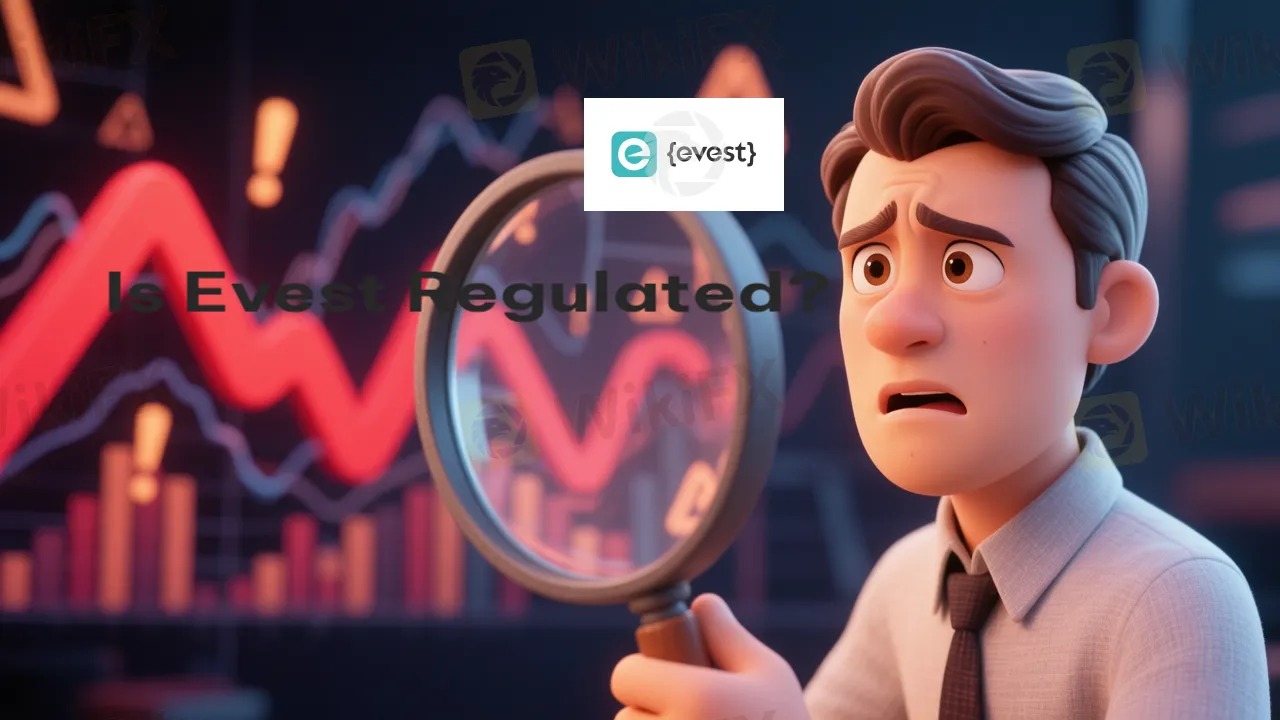
In the fast-moving world of online trading, the most important thing for protecting your investments is not studying the market or having a good trading plan—it is making sure your broker is properly regulated. A license is much more than just paperwork; it is your main protection. When we look at Evest, the question “Is Evest regulated?” has a complicated answer. While the broker does have licenses, our research has found serious warning signs, a confusing company structure, and many concerning complaints from traders that need careful attention. This complete guide will get straight to the point. We will look at Evest's official licenses right away, break down the complex company structure behind the brand, examine the serious complaints from users, and give you our final judgment. Our research uses information that is available to the public from regulatory agencies and verification websites. We strongly encourage all traders to do their own research on websites, such as WikiFX, before investing.
Evest's Official Profile
To start our analysis, we need to first present the basic, official facts about Evest's company registration and licenses. This information, shown by the broker and confirmed in public records, gives us a factual starting point before we begin our critical review. Showing these details clearly is important for building a complete picture.
Corporate Entity Details
The parent company behind the Evest brand is registered in the United Kingdom. This company serves as the main company for the various operations.
Declared Licenses
Evest operates under two different regulatory licenses from different global locations. The quality and level of protection offered by these licenses are very different, which is an important point for any potential client to understand.
Understanding the Licenses
Having licenses is the first step, but for an experienced trader, the important question is: which licenses? Not all regulatory agencies are the same, and the level of protection they offer can be very different. Understanding what Evest's FSCA and VFSC licenses really mean for you is essential for properly assessing risks.
The FSCA License
The Financial Sector Conduct Authority (FSCA) of South Africa is a legitimate and recognized financial regulator. Having an FSCA license means Evest is subject to some oversight within that area. This regulation typically requires brokers to follow specific financial standards, maintain clear operations, and follow rules of conduct designed to protect local consumers.
However, it is important to understand that the FSCA is not considered a top-level global regulator in the same category as the UK's Financial Conduct Authority (FCA), the Australian Securities and Investments Commission (ASIC), or the Cyprus Securities and Exchange Commission (CySEC). The protections, compensation programs, and enforcement mechanisms, while valuable for South African residents, may not be as strong or easily accessible for international clients trading with the broker.
The VFSC Offshore Flag
Evest's second license is from the Vanuatu Financial Services Commission (VFSC). This is classified as “offshore regulation,” a term that should immediately signal caution for any serious trader. Offshore locations are often chosen by brokers for several reasons, none of which primarily benefit the client.
Key characteristics of offshore regulation include:
· Lower Capital Requirements: Brokers can often start with much less capital than in top-level locations, raising questions about their financial stability.
· Less Strict Oversight: Reporting standards and ongoing supervision are typically much more relaxed, giving the regulator less insight into the broker's daily operations.
· Limited Options for Help: Most importantly, offshore regulators rarely provide investor compensation programs. If the broker fails or engages in bad behavior, getting your funds back is extremely difficult, if not impossible.
For traders, this translates directly into weaker protection and a much higher risk profile. The presence of an offshore license is a significant warning sign.
What's Missing?
Perhaps the most telling aspect of Evest regulation is not what it has, but what it lacks. The parent company, ATRIAFINANCIAL HOLDINGS LTD, is registered in the United Kingdom, a global financial center. Yet, Evest does not hold an Evest license from the UK's FCA, one of the world's strictest and most respected regulators. Furthermore, public records show a related company, ATRIAFINANCIAL BUSINESS SERVICES LTD, based in Cyprus. Again, there is no corresponding CySEC license. This pattern of establishing corporate entities in top-level locations without obtaining the respective top-level licenses is a classic strategy that should raise suspicion. It allows a broker to project an image of legitimacy while operating under the weaker protection of offshore rules.
Contradictions and Complexity
An important part of research is looking beyond the surface claims and analyzing the contradictions. With Evest, a deeper look reveals a complex corporate structure and conflicting information that raises serious questions about transparency and operational integrity. These inconsistencies help explain why the broker is flagged for “High potential risk” despite being technically licensed.
“Regulated” vs “High Risk”
How can a broker be both “regulated” and simultaneously flagged as a “high potential risk”? The answer lies in the quality of the regulation and the broker's actual conduct. The combination of a single mid-level license (FSCA) and a weak offshore license (VFSC) provides only a thin appearance of legitimacy. This is easily broken by the overwhelming volume of severe user complaints. Verification websites often use systems that consider not just the presence of a license, but also its quality and the real-world experiences of traders. When complaints about withdrawal issues and aggressive sales tactics pile up, risk warnings are triggered.
The MT5 License Mystery
One of the most obvious contradictions found in public data about Evest is the “MT5 Full License” tag. This suggests the broker operates on the globally recognized MetaTrader 5 platform. However, a detailed review and Evest's own marketing materials from 2025 confirm this is not the case. The broker does not support the MT4 or MT5 platforms, instead directing users to a proprietary trading app. This is not a minor error. The MT4/5 system comes with a certain level of technical standards and user expectations. Presenting itself as an MT5 broker while not offering the platform is, at best, misleading and raises serious questions about the broker's transparency.
A Complex Corporate Web
The structure behind the Evest brand is not straightforward. Our investigation reveals a network of related companies that complicates the picture of who is responsible for what.
· Holding Company: ATRIAFINANCIAL HOLDINGS LTD (United Kingdom)
· Related UK Entity: ATRIAFINANCIAL CAPITAL LIMITED (United Kingdom)
· Related EU Entity: ATRIAFINANCIAL BUSINESS SERVICES LTD (Cyprus)
Such complex structures can be legitimate, but they can also be used for regulatory arbitrage—the practice of exploiting loopholes between different legal systems to minimize oversight and financial obligations. For a trader, it can be nearly impossible to determine which company they are actually contracting with and under which legal system their funds are truly held. Understanding these corporate networks is a key part of research. We strongly advise traders to use the 'Genealogy' and 'Related Companies' features on a verification website, such as WikiFX, to see the full picture behind a broker's brand name.
The Voice of the Trader
Regulatory analysis and corporate breakdown provide a framework for risk, but the most powerful evidence comes from the real-world experiences of those who have trusted the broker with their capital. An analysis of public complaints filed against Evest in late 2024 and early 2025 reveals a disturbing and consistent pattern of serious issues, painting a picture of a high-pressure environment where client interests are secondary.
Common Complaint Themes
The issues reported by Evest users are not isolated incidents but form a clear and recurring pattern. These themes should serve as a strong warning to any potential trader.
· Aggressive Account Management: A large number of complaints detail account managers constantly pressuring clients to deposit more funds. This pressure often increases with promises of taking advantage of upcoming market events, creating a sense of false urgency.
· Withdrawal Obstacles: This is one of the most common and serious complaints. Users report extreme difficulty, long delays, and in many cases, outright refusal when attempting to withdraw their own funds and profits.
· Pressure to Sell Assets: In some of the most disturbing accounts, users claim that Evest managers encouraged them to sell personal property, such as cars and gold, to deposit more into their trading accounts, often presented as a way to “make up for losses.”
· Loss of Funds and Lack of Help: The common thread in these stories is the eventual loss of the entire account balance. Following these losses, traders report that their once-attentive account managers become unreachable, leaving them with no support or help.
· Claims of Manipulation: Some users claim their substantial losses were a direct result of following specific, high-risk trading advice provided by their account managers, suggesting a conflict of interest where the manager's advice benefits the broker, not the client.
Trader Case Examples
To make these risks real, consider these summarized but representative experiences drawn from public forums:
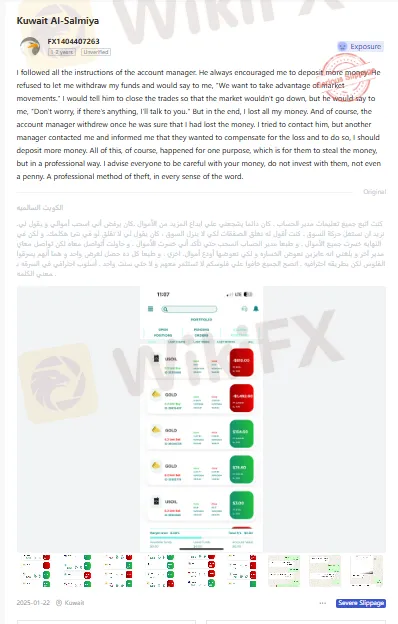
One trader from Kuwait detailed a scenario where their account manager consistently discouraged withdrawals, insisting on the need to “take advantage of market movements.” The trader's requests to close positions were ignored. Ultimately, this led to a complete loss of funds, after which the account manager disappeared. When the trader tried to follow up, a different manager contacted them, not to help, but to suggest depositing more money to “make up for the loss.”
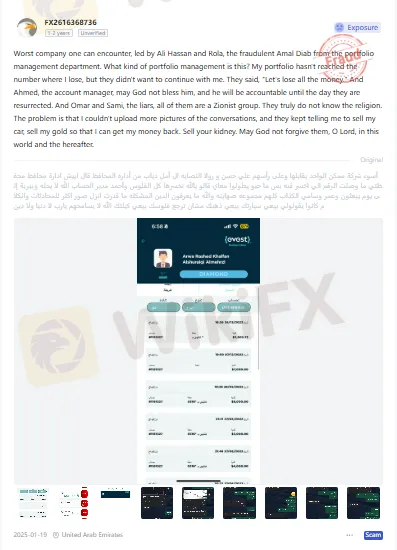
Another highly concerning report from a user in the United Arab Emirates involved multiple account managers allegedly pressuring the client to sell their car and gold. The reason given was that this was necessary to “get their money back” after a series of losses. This is a classic, predatory high-pressure sales tactic that has no place in a legitimate financial advisory relationship.
A Cautious Verdict
After a thorough examination of Evest's regulatory claims, corporate structure and the documented experiences of its users, we can now combine our findings into a clear and actionable conclusion. The goal is to provide a definitive answer to the question of Evest's safety and legitimacy.
The Full Picture
Here is the summary of our investigation. Evest holds a mid-level license from South Africa's FSCA and a weak, low-protection offshore license from Vanuatu's VFSC. This “regulated” status is, in our expert opinion, severely undermined by several critical factors. These include a deliberately complex and unclear corporate structure, obvious contradictions in public information regarding its trading platforms, and, most importantly, an overwhelming volume of severe and consistent user complaints. The claims of withdrawal obstruction and aggressive, predatory tactics from account managers paint a picture of a high-risk environment for traders.
Final Takeaway
Based on the extensive evidence of operational warning signs and the significant potential danger to client capital, we must advise traders to exercise extreme caution. The combination of a weak regulatory framework, a non-transparent corporate web, and widespread, serious user complaints regarding the most fundamental aspect of brokerage—the withdrawal of funds—is an unacceptable risk. We cannot recommend this broker. The pattern of behavior reported by users presents a significant danger to your financial well-being.
Your financial safety is most important. Before engaging with *any* broker, especially one with numerous warning signs such as Evest, you must perform your own research. Use a comprehensive verification tool, such as WikiFX, to check its full, up-to-date profile, including all licenses, risk warnings, and the latest user reviews. A few minutes of independent research is the best investment you can make to protect yourself from potential financial harm.
Scan this QR code below to know the latest forex insights, trends, news and other updates.