

Global Broker Regulation Inquiry App
About WikiFX
English
简体中文
繁體中文
English
Pусский
日本語
ภาษาไทย
Tiếng Việt
Bahasa Indonesia
Español
हिन्दी
Filippiiniläinen
Français
Deutsch
Português
Türkçe
한국어
العربية
Strait Shutdown and Escort Deadlock Push Global Energy Into Survival Mode
Abstract:[Figure 1: Strait Confrontation Overview]Shipping traffic through the Strait of Hormuz dropped to zero on March 14, marking a historic disruption in one of the world‘s most critical energy corridors.

[Figure 1: Strait Confrontation Overview]
Shipping traffic through the Strait of Hormuz dropped to zero on March 14, marking a historic disruption in one of the world‘s most critical energy corridors. President Trump hinted at the possibility of striking Kharg Island, the heart of Iran’s crude export infrastructure, prompting Tehran to threaten decisive retaliation and reveal that it has buried highly enriched uranium as a strategic deterrent.
With the global energy supply gap estimated to reach 10 million barrels per day, Western allies are now showing significant fractures over military escort operations in the region.
Shipping and energy infrastructure across the Gulf region is approaching a point of systemic breakdown:
Hormuz traffic halted: Vessel traffic dropped to zero for the first time on the 14th, effectively cutting off a channel responsible for roughly 20% of global energy flows. Although U.S. Treasury Secretary Scott Bessent suggested Washington may tacitly allow certain Iranian tankers to depart to stabilize supply, the security of the shipping lanes has effectively collapsed.
Kharg Island crisis: Trump‘s signal that the island could become a military target has heightened tensions. If the facility responsible for around 90% of Iran’s oil exports were damaged, Tehran has warned it would retaliate against all U.S. assets in the Middle East.
Fujairah under attack: The UAE port of Fujairah, the countrys only export route bypassing the Strait of Hormuz, was attacked again on Monday, forcing the suspension of loading operations. This incident effectively eliminated the last remaining supply contingency, pushing WTI crude prices toward the $100 mark.
Market estimates suggest Middle Eastern oil output has already declined by 7–10 million barrels per day, an unprecedented supply shock:
United Arab Emirates (ADNOC): Large-scale production shutdowns have cut daily output by more than half.
Saudi Arabia and Iraq: Saudi production has fallen roughly 20%, while Iraqi exports have plunged around 70% due to logistical disruptions.
Market response: Despite the massive supply gap, Bessent maintains that oil prices could fall well below $80 within months. This strategic optimism contrasts sharply with current market realities near $100 oil, suggesting the White House is attempting to manage public expectations under extreme pressure.
Iran also announced that it has buried approximately 440 kilograms of uranium enriched to 60%, stating it has no immediate intention to retrieve it. This move represents a classic nuclear deterrence signal, warning that any ground operation by the U.S. or Israel to seize the material could lead to catastrophic consequences.
Meanwhile, Tehran has broadened its retaliation strategy:
On Monday, Iran reportedly struck U.S. military bases in Qatar and the UAE.
Iranian officials also warned that U.S. industrial and logistical networks across the Middle East could become targets in future responses.
Analyst‘s Assessment
Energy Prices
WTI crude currently trades around $98.59, while Brent remains above $103. Until operations at Fujairah are fully restored, downside risk for oil prices appears extremely limited.
European Equities
Although the STOXX 600 index has shown a technical rebound, its two-week losing streak reflects growing investor concern that the conflict may become prolonged, overshadowing earlier expectations of a resolution within four to six weeks.
Geopolitical Fragmentation
The failure to establish a unified escort coalition highlights weakening U.S. mobilization capacity in regional security affairs. Resistance from key allies, particularly France and Germany, suggests that post-war influence in the Middle East could undergo a significant realignment.
[Figure 2: Gold H1 Hourly Technical Analysis]
If prices break below 5000, the market could extend losses toward 4980 or even 4950.
Conversely, if gold holds above 5000 and reclaims the 5050–5100 range, a rebound toward the 5100–5200 resistance zone may develop.
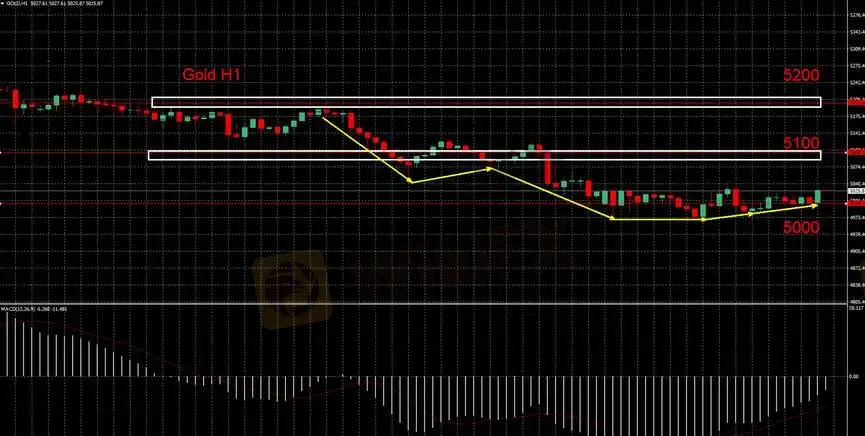
Gold’s H1 (1-hour) chart currently shows a range-bound but bearish-leaning structure. After encountering strong resistance near 5100, prices retreated and broke below prior support levels, briefly falling toward 5000 before stabilizing.
Recent price action has been confined to a narrow consolidation range between 5000 and 5030, indicating some buying interest near the psychological support level. However, the broader technical structure still reflects a low-level consolidation within a downward trend.
Until prices firmly reclaim 5100, the short-term structure should still be viewed as range-bound with a bearish bias.
Risk Disclaimer:
The views, analyses, research, prices, or other information provided above are for general market commentary only and do not represent the position of this platform. Any individual accessing this information assumes full responsibility for their investment decisions. Please trade with caution.
Disclaimer:
The views in this article only represent the author's personal views, and do not constitute investment advice on this platform. This platform does not guarantee the accuracy, completeness and timeliness of the information in the article, and will not be liable for any loss caused by the use of or reliance on the information in the article.
WikiFX Broker
Latest News
AssetsFX Safety Review: Understanding the Warning Signs and User Concerns
 WikiFX
Top 5 Reasons Why Rupee Slips Below 95 Twice in 2026
WikiFXSwissquote Review 2026: Regulation, Account Delays, and Trader Complaints
WikiFXMalaysians Arrested in Singapore for Collecting Cash on Behalf of Transnational Scammers
WikiFXALPEX TRADING Review 2026: Is this Forex Broker Legit or a Scam?
WikiFXCore inflation rate hit 3.2% in March as first-quarter growth disappointed at 2%
WikiFXWikiFX Wishes You a Happy Labour Day
WikiFXInside the Fed: Powell vows he won't be a 'shadow chair,' but a Warsh clash will be tough to avoid
WikiFXDbinvesting Exposed: Inside the Shocking Fund Scam Allegations Traders Can’t Ignore
WikiFXZaffex Review 2025: Is This Forex Broker Safe?
WikiFXCurrency Calculator
USD

CNY
Current Rate:0
Enter amount
USD
Redeemable Amount
CNY
Calculate 