

Global Broker Regulation Inquiry App
About WikiFX
English
简体中文
繁體中文
English
Pусский
日本語
ภาษาไทย
Tiếng Việt
Bahasa Indonesia
Español
हिन्दी
Filippiiniläinen
Français
Deutsch
Português
Türkçe
한국어
العربية
اردو


US-EU Trade War Escalates: Trump's Greenland Ultimatum Triggers 'Nuclear' Financial Threat

WikiFX
|


Abstract:Transatlantic tensions escalate as President Trump threatens 10% tariffs on European allies over the Greenland dispute, prompting the EU to consider weaponizing its $8 trillion in US asset holdings.
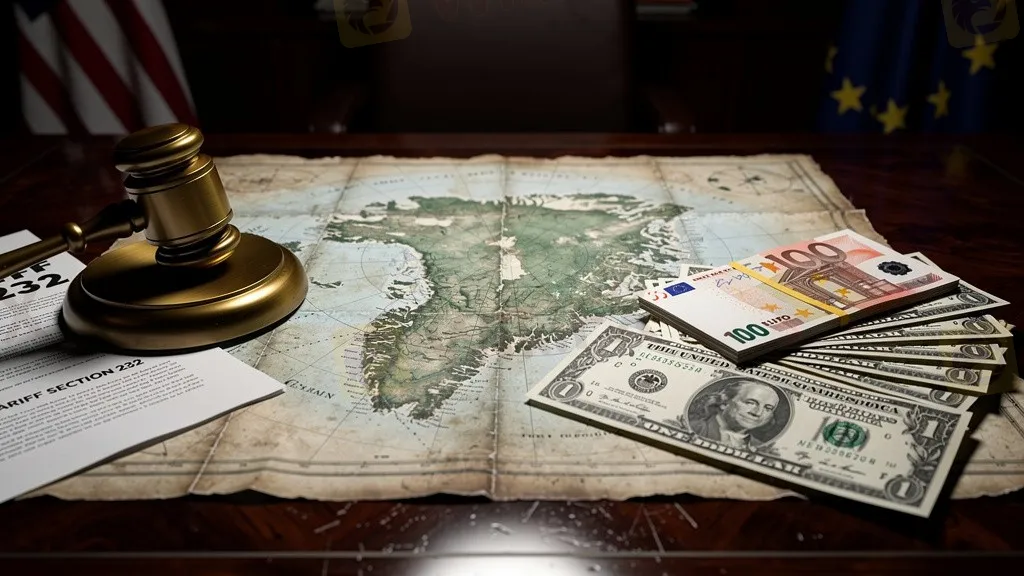
Washington/Brussels — The fragility of the transatlantic alliance is facing its severest test in decades. Following President Trumps deadline for the acquisition of Greenland, the White House has formally threatened to impose a 10% tariff on eight European nations—including the UK, Germany, and France—starting February 1, escalating to 25% by June if a deal is not reached.
The geopolitical maneuver has moved beyond rhetoric into military signaling, with NORAD confirming the deployment of aircraft to the Pituffik Space Base in Greenland. The market reaction has been swift, with risk premiums rising globally as investors price in a structural fracture in Western trade relations.
Data Snapshot
- Tariff Ladder: Initial 10% tariff begins February 1, increasing to 25% by June.
- Capital Exposure: Europe currently holds approximately $8 trillion in US equities and bonds.
The EU's 'Nuclear Option': Weaponizing Capital
European leaders are scrambling to form a unified response. While Frances Emmanuel Macron advocates for activating the EU's Anti-Coercion Instrument (ACI) to block US services and investment, a more severe financial threat is gaining traction in market circles.
Deutsche Bank strategists highlight a potential “capital weaponization” scenario. Europe holds approximately $8 trillion in US equities and bonds. While a coordinated liquidation by European private sectors is logistically difficult, the mere discussion of “dumping Treasuries” by EU officials has injected toxicity into the US bond market.
Intra-EU Split: Hawk vs. Dove
- The Hawk: France is pushing for immediate retaliation, viewing the tariffs as “unacceptable blackmail.”
- The Dove: Germanys Chancellor Friedrich Merz, citing the German economy's export sensitivity, is urging “calm rationality” and plans to meet Trump in Davos to negotiate a de-escalation.
Market Impact
The standoff is reshaping FX flows. The US Dollar (USD) is struggling to capitalize on risk aversion due to the specific political risk attached to US assets. Conversely, the Euro (EUR) remains volatile, caught between the economic damage of potential tariffs and the hawkish tilt of the ECB, following the nomination of Croatian hawk Boris Vujcic as Vice President.
Disclaimer:
The views in this article only represent the author's personal views, and do not constitute investment advice on this platform. This platform does not guarantee the accuracy, completeness and timeliness of the information in the article, and will not be liable for any loss caused by the use of or reliance on the information in the article.
WikiFX Broker
Latest News
Winvest Review: Is Your Deposit Safe?
WikiFXKCB Review: Is Your Deposit Safe?
WikiFXCrypto Revenue Falls in Q2 as Another Platform Moves Into CFDs
WikiFXOcta Review 2026: Severe Withdrawal Complaints and High Risk Signals
WikiFXWhy More Commodity Revenue Doesn't Instantly Strengthen a Currency
WikiFXExness Review for Indian Traders 2026: The RBI Question Comes Before Leverage and Spreads
WikiFXEMAR MARKETS Review 2026: Severe Withdrawal Complaints and Risk Signals
WikiFXTrader's Way Review: Trades Vanished Overnight , And There's No Regulator to Call
WikiFXLockwood Review: AMF-Blacklisted Broker with Users Reporting Blocked Withdrawals
WikiFXBYBIT Review: What Traders Should Know Before Depositing
WikiFX