Abstract:Asian stocks ticked up to their highest in more than a month supported by broad gains on Wall Street on Tuesday, while the euro was stuck near a one-week low against the dollar amid talk of more sanctions against Moscow.
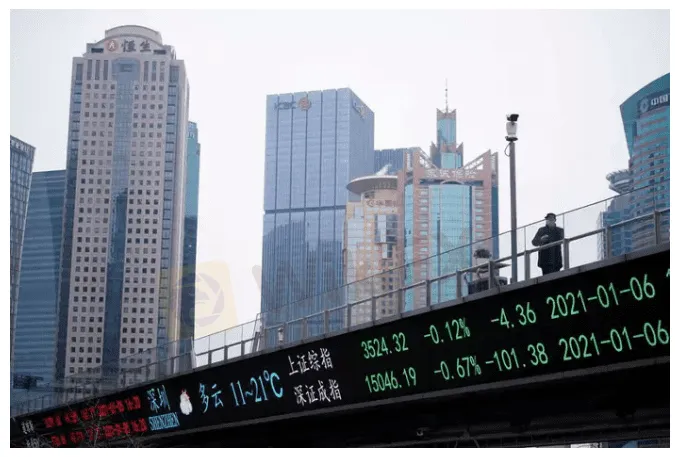
Stocks on global indexes fell on Tuesday while U.S. Treasury yields rose to multi-year highs as comments from U.S. Federal Reserve Governor Lael Brainard put investor focus on the possibility of aggressive monetary policy tightening by the central bank to curb inflation.
The U.S. dollar hit its highest in nearly two years.
Brainard said she expects a combination of interest rate increases and a rapid balance sheet runoff to bring U.S. monetary policy to a “more neutral position” later this year, with further tightening to follow as needed.
Separately, San Francisco Fed President Mary Daly pointed to the next meeting, scheduled for May 3-4, as a possible start to the balance sheet reduction.
Wednesday brings the release of minutes from the Feds last policy meeting. The ECB will publish its equivalent minutes on Thursday.
Tech and growth shares led the decline on Wall Street, with higher rates seen as a negative for growth stocks.
“For the rest of this week, the market will be driven by interest rates and it will be driven by the Feds comments about interest rates,” said Peter Tuz, president of Chase Investment Counsel in Charlottesville, Virginia.
Investors were also keeping a close watch on developments on Russias invasion of Ukraine, with the West preparing to expand sanctions to include a ban on all new investments in Russia.
Ukrainian President Volodomyr Zelenskiy told the U.N. Security Council on Tuesday that Russia must be held accountable over allegations of war atrocities.
The Dow Jones Industrial Average fell 280.7 points, or 0.8%, to 34,641.18, the S&P 500 lost 57.52 points, or 1.26%, to 4,525.12 and the Nasdaq Composite dropped 328.39 points, or 2.26%, to 14,204.17.
The pan-European STOXX 600 index ended up 0.2% and MSCIs gauge of stocks across the globe shed 0.97%.
In Treasuries, the yield on 10-year Treasury notes was up 13.1 basis points to 2.543%, while the 2-year note yield was up 7.2 basis points at 2.500%, leaving the 2-10 spread at 3.97 basis points after having been negative for the most part since last week.
The dollar index rose as high as 99.526, the highest since late May 2020.
The euro weakened amid concerns about the outcome of the French elections. It was down 0.6% at $1.0901 and matched a low of $1.09 hit on March 14.
The Australian dollar gained, boosted by the prospect of policy tightening by the Reserve Bank of Australia. The Aussie dollar rose 0.4% to US$0.77521, while the New Zealand dollar gained 0.2% to US$0.6937.
Soaring global energy and food prices mean almost 60% of developed economies now have year-on-year inflation above 5%, the largest share since the late 1980s, while it is above 7% in more than half of the developing world.
Oil prices eased Tuesday, partly because of the rising U.S. dollar and increasing COVID-19 cases.
Brent futures fell 89 cents, or 0.8%, to settle at $106.64 a barrel, while U.S. West Texas Intermediate (WTI) crude fell $1.32, or 1.3% to settle at $101.96.
(Additional reporting by Lewis Krauskopf and Rodrigo Campos in New York and Marc Jones in London; Editing by Nick Macfie, Will Dunham, Ed Osmond and Andrea Ricci)