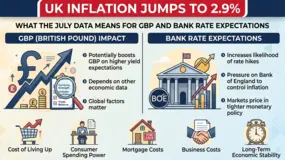
UK Inflation Jumps to 2.9%: What the July Data Means for GBP and Bank Rate Expectations
UK CPI rose to 2.9% in July 2026 from 2.6% in June. See what the data may mean for GBP, gilt yields and Bank Rate expectations without overreading one release.
简体中文
繁體中文
English
Pусский
日本語
ภาษาไทย
Tiếng Việt
Bahasa Indonesia
Español
हिन्दी
Filippiiniläinen
Français
Deutsch
Português
Türkçe
한국어
العربية
اردو
Abstract:Venezuela's annual inflation rate hit 686.4% in 2021, demonstrating a deceleration of consumer price growth versus the previous year when inflation was 2,959.8%, the country's central bank said on Saturday.

Venezuela's annual inflation rate hit 686.4% in 2021, demonstrating a deceleration of consumer price growth versus the previous year when inflation was 2,959.8%, the country's central bank said on Saturday.
Monthly inflation in December rose 7.6% and, since September, the inflation rate has remained in the single digits.
The deceleration in prices follows government measures which include the restriction of credit and lower spending in bolivars to maintain the stability of the exchange rate.
As a result of this strategy, government entities and state-owned oil company PDVSA now pay suppliers in cash with foreign currency.
During an interview broadcast on state television at the start of this month, Venezuela's President Nicolas Maduro said hyperinflation - which ran for four years - had been left behind.
Despite measures to improve supplies and control inflation, prices remain high and continue to hit the earnings of Venezuelan families, limiting their ability to buy goods like food and medicine. A minimum monthly salary is equivalent to $1.50.
In 2019, amid hyperinflation and economic collapse, Venezuela's government relaxed economic controls, allowing greater quantities of foreign currency to circulate, which provided some sectors with breathing space.
The central bank has yet to publish data regarding the country's economic growth.
For more Forex news, please download WikiFX- the Global Forex Regulatory Inquiry APP.

Disclaimer:
The views in this article only represent the author's personal views, and do not constitute investment advice on this platform. This platform does not guarantee the accuracy, completeness and timeliness of the information in the article, and will not be liable for any loss caused by the use of or reliance on the information in the article.

UK CPI rose to 2.9% in July 2026 from 2.6% in June. See what the data may mean for GBP, gilt yields and Bank Rate expectations without overreading one release.

US wholesale inflation slowed sharply in July, encouraging investors to reduce their bets on another Federal Reserve rate hike. Dig beneath the headline, however, and persistent core price pressures suggest the inflation battle is not over.

Despite frequent “de-dollarization” headlines, the U.S. dollar remains unrivaled due to unmatched market depth, global usability, and trusted legal/institutional frameworks. Crypto and other currencies (euro, yuan) lack the stability, convertibility, and infrastructure required to replace the USD, while the Fed’s credibility and the scale of U.S. financial markets continue to anchor demand. Bottom line: no alternative currently offers a complete, credible substitute for the dollar’s global role.

The U.S. will impose an additional 100% tariff on Chinese imports starting Nov. 1, 2025—potentially earlier—alongside new export controls on “critical software,” escalating tensions after Beijing’s rare-earth curbs, new port fees, a Qualcomm probe, and a halt to U.S. soybean purchases. Stocks fell on the news. Key context: some U.S.-China tariffs remain paused until Nov. 10, a Supreme Court case could reshape Trump’s tariff authority, new U.S. duties on cabinets (Oct. 1) and wood products (Oct. 14) are in force, and a pause on Mexico tariffs is set to end next month.